
Over the last few years, countless forms of media have been created, with people from all corners of the internet giving commentary on why Gen Z men are acting, feeling, and voting the way they do in the United States. Questions on the topics of the rise of incels, the male loneliness epidemic, the extreme rightward shift in their politics, and why they're falling so far behind women of their shared age academically, socially, and career-wise have seen no shortage of attention from journalists, TikTokers, and Substackers. If you have any previous familiarity regarding these topics, you're likely thinking that this discourse is analyzing the same type of man, and I would agree. If you were to construct a Venn diagram placing the men being scrutinized into four circles of the previously mentioned topics, you'd likely end up with a perfect circle. For some, it should be pretty easy to see the correlation between these groups. But the attention has recently shifted away from them—a new genre of young men has recently been catapulted to the forefront of online discourse: the Performative Man.
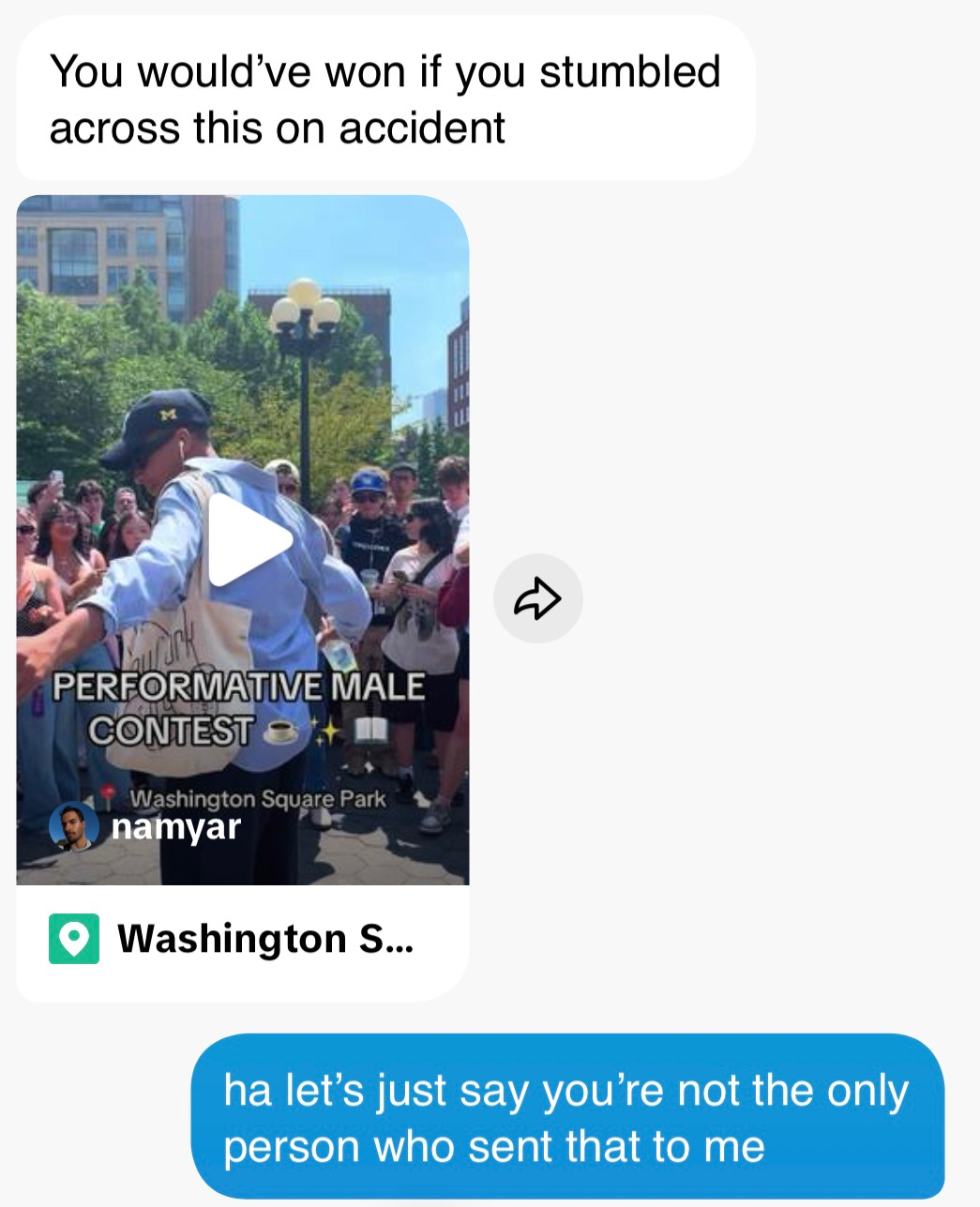
The influx of Performative Man content began to appear on my online feeds around February of this year. As the year moved along, an increase in the content followed. What began with Instagram meme pages cracking jokes about men in baggy jeans drinking matcha lattes or TikToks about men posting Instagram photo dumps to Laufey songs expanded as more and more people began to create content about this archetype of man. The dialogue appeared to reach its climax last week like all other 2025 trends do—a Performative Man lookalike contest in Washington Square Park. Much to my surprise, the conversation continued, and on July 31st, Ekta Sinha released a piece in Elle magazine titled "Forget The Lonely Man Epidemic — The Performative Male Era is Here. And We Need to Talk (And Run)." The article gives quite a scathing review of the men in question, calling them out as Clairo-listening, Sally Rooney-reading, Co-Star-using, therapy-going, shallow men. Sinha claims they partake in these activities not because they're actually interested in Clairo or astrology, but because it helps them get laid. This in itself is the idea of the Performative Man: someone whose personality is entirely fabricated in an attempt to manipulate potential partners. To Sinha's credit, her solution for this problem is for men to self-reflect and self-police. My concern is we've reached a point where society gets to decide what is and what is not authentic—what hobbies, artists, musicians, and drinks are acceptable for men to enjoy.
Thanks for reading Jack’s Newsletter! Subscribe for free to receive new posts and support my work.
I'm writing this under the assumption that those who will be reading likely have some flavour of a personal relationship with me. Some of you are likely thinking, "Jack, of course you have a problem with this—it's because you're the one finally being scrutinized." Perhaps that is true. (I did have multiple people tell me I would've won the lookalike contest, a complete misread on their parts. I have no mustache and my summer wardrobe consists of linen and Lululemon. Find me the JP Morgan analyst lookalike contest and buy me a used Datejust. Maybe then I have a chance.) I do check my Co-Star app almost daily, and Lana del Rey was my fifth most listened to artist on Apple Music last year (I don't use Spotify—checkmate, liberals). I also did not provide 3,000 words of my thoughts defending the incels who were under the internet's microscope previously, even though I was constantly chatting about it with everyone I interacted with. This may come as a surprise to some, as I'm often criticized for being too black and white on complex issues, but my opinions on the incels are quite nuanced, often changing depending on the conversation.
My sympathy for them stems from the fact that many of them fell down this path by little fault of their own. COVID lockdowns stunted the growth of their social skills, online school robbed them of some critical life experiences, and tech companies shaped their algorithms, effectively killing two birds with one stone. Not only are the algorithms causing skyrocketing screen times and addiction rates in the youth, helping big tech's bottom line, they're also shaping the views of a population who are just of voting age. This results in voting patterns from these groups supporting candidates more likely to create far more favorable legislation for these same companies—a win-win for big business, a loss for the rest of society. But my sympathy only goes so far. Anyone who has spent more than three minutes talking to me is aware of the fact that the American version of "personal responsibility" is not one I hold in high regard. However, some of these incel men need to get a grip. It's not that hard to attend social gatherings, join a club or rec sports team, or have meaningful emotional conversations with your friends. Yet it seems that these commonly accepted solutions to the problems these men are facing are simultaneously being deemed as inauthentic or performative when men actually are participating in them. This contradiction may be a reach, but as I continue, I'll keep listing my grievances and why I feel qualified to comment on them.
In January 2021, Sophia tweeted, "being in your 20s is just like going back to liking everything you liked when you were 13 but without being ashamed." I remember the self-reflection this caused and the conclusion that followed. I had quite the unique childhood—good old St. Johnnyville isn't exactly a bustling metropolis despite what Donny Schoff has to say. With school class sizes ranging from about 25-50 depending on the year, the friends you made in kindergarten were often the friends one had in their senior year of high school. With one elementary and middle school in the district, my friends and I never had to face the daunting task of making new friends at the beginning of middle school or high school like most other American students. A student's experience in this type of environment is dependent on many variables, some of which are out of their control. But one thing is undeniable: the cliquey environment that plagues many of the high schools in the country is almost nonexistent there. My friends and I were super privileged—there was no need to fit in.
The eight or nine of us all had nearly identical schedules, and many of us played on the same athletic teams; we were regularly spending 9-10 hours a day together. Obviously, this isn't exactly going to create an environment where one will feel the need to fit in or conform to a clique. The point is, you can't kick your lifelong friend out of your chemistry class because you think it's weird they like the video game Smite when the school only offers one chemistry class—we had the privilege of being able to like what we wanted without much pushback. I could play Speak Now from start to finish on the way to a team bowling outing on Thursday night, while not having to worry about whether or not Mo was gonna swing me the ball that Friday for an open 3 as we beat Canajoharie for the nth time in a row. The tweet made me realize this wasn't a shared experience for most. There's a Phoebe Bridgers quote (the jokes write themselves, I know) about not being afraid of liking things she really enjoys: "Don't be afraid of liking stuff, it's okay. I don't really believe in guilty pleasures... your friends will pretend to like it if you like it, you invent what cool is." For many people in their twenties, this is the first time since their childhood that they're able to really be authentic versions of themselves. Who are we to tell them they can't drink matcha without being performative?
I vividly remember the first time I heard the phrase "toxic masculinity." In my senior year of high school, I took a creative writing/public speaking class. I'm not one for writing and I do not think I've ever once been described as creative, but some of my friends and I took it together. We earned three college credits and it was taught by a teacher we had a great relationship with—it was our third year with her. I'll do my best to paint you a picture of this woman: she was a Pearl Jam superfan who loved Bernie Sanders nearly as much as Eddie Vedder. This flavour of English teacher, while common elsewhere, was a rarity in my neck of the woods. Moral of the story—she played a role in shaping the politics (perfect, may I add) that I have today.
One day, early spring I think, she came in asking us if we saw the latest Barbasol commercial regarding "toxic masculinity." This was my first time hearing of the term, and like my other classmates, I hadn't the slightest idea what she was talking about. The following 40 minutes consisted of multiple watches of the video and a pointed attack, albeit a convincing one, on much of man's perspective on what masculinity entails. I was obnoxiously SJW in high school, but the idea of emotional vulnerability was not one I was on board with. 2019 and the societal climate that existed then feels like a lifetime ago, but it seemed as if real progress was made by men in terms of opening up emotionally. In 2019, only 10.1% of American men received mental health treatment or counseling. By 2023, the number increased by more than 50%, with 17.1% of American men receiving treatment or counseling. While we wait for more recent data, I can't help but think that the attack on the Performative Man who goes to therapy and speaks about his feelings will result in a decrease in these numbers.
I am already aware of the counter to this. It's not that we don't want men to go to therapy and be vulnerable or drink Dirty Shirleys. We just want them to be authentic about it. Unfortunately, I'm afraid our society in this current political climate is not capable of such nuance. I can't help but draw the conclusion that "Boy, turn off that Clairo and grab a beer" is not too far off from the common phrases such as "Be a Man," "Grow a Pair," "That's Gay," or anything of the like that the toxic masculinity discourse was so critical of. I'm not one to police language, but the hypocrisy that the same flavours of people who claimed to care so much about correcting the behaviours of men to improve society are now chastising them back into regression is concerning. I'm purposefully roleplaying a polemicist here—I understand it's a funny meme and it's not that deep. But, as a girl far smarter than me recently said, "Jack, it's always that deep," and I'm afraid she may have a point.
That response was in regards to my thoughts on a TikTok she sent me. A man was explaining how his 23-year-old best friend was effectively giving his girlfriend $500 a month with no questions asked. The comments were filled with men fantasizing over the idea of being able to do this one day and women likewise fantasizing over being in the aforementioned girlfriend's position. She argued that this lump sum screamed allowance, and allowance screams a power dynamic in a relationship that is quite problematic in the year 2025. While I agreed we should not return to the age where men in heterosexual couples were providing their partners with an allowance, I claimed that I did not believe a reasonable person would take something like this seriously. Although I'm constantly deemed a cynic, I can be naively idealistic at times. So I continued that most people are normal—they're looking for emotional connection, chemistry, fun dates, and witty banter. Most people are not expecting a $500 Venmo every four weeks. Those who are are just chronically online freaks not living in reality, and not a general representation of society. But as I reflect back over the changes in popular content over the last couple years, and the current political and societal environment we find ourselves in, I think I may have been wrong.
A trend I began to notice online roughly around the end of 2023 or beginning of 2024 was the rise of young women wanting to infantilize themselves around potential male partners. This likely coincided around the time the "I'm just a girl" trend began, which I'm now having a revelation that this trend may have been the true beginning of this specific domino effect. What began as a silly online bit about not wanting to start a Roth IRA or eat protein with dinner slowly began to turn darker. Some began to become more comfortable claiming that they love turning their brains off when they're with their boyfriend. Or that Grandma didn't have it that bad—I work a 9-5 and she just had to cook one meal and do laundry all day. As the year progressed, a different archetype of young person was the topic of conversation. This time a girl—the Tradwife. I'd like to make a disclaimer here: I'm not blaming the "I'm just a girl" trend for the rise of the Tradwife; I'm just trying to make a point. Once you begin to give credence to a somewhat controversial opinion or the more you begin to normalize dangerous rhetoric, the more prevalent it will become. The more girls see other girls just like them saying they'd rather stay at home and cook rather than have a career, the more likely they are to develop that opinion. The more men see that therapy or liking musical artists with female target audiences or being emotionally vulnerable is seen as performative (BECAUSE WE ARE INCAPABLE OF NUANCE), the less likely they will be to participate in those things. I hope you follow. Those TikToks about turning your brain off around your boyfriend weren't that deep, until your daughter dies of measles because some moron who saw it decides not to vaccinate their child.
Let people like things, let people learn things, let people participate in things. Men who create inauthentic personalities in an attempt to get laid are not a new phenomenon—they're just manipulative freaks; they've always existed. If you were to ask a Gen Z woman if a man of similar age she'd never met who was wearing a beanie and thrifted jeans was a manipulative freak, I hypothesize she'd be far less likely to say yes than if you asked if he was a performative man. That's my issue with the discourse.
Two of my friends from home are public school teachers. Nicky teaches fifth grade math and Jason teaches high school history. They often ragebait each other into a useless argument over what subject is most important for students' development. This repetitive conversation shines a light on two different issues. The first being the fetishization of STEM in the US over the last half decade. The other being the hyperspecialization of education and, in turn, our society. The STEM topic we'll save for another day, but the second issue I believe is relevant to the point here. The focus of pushing students into one niche direction from a young age determines the things they learn, the things they read, and the things they like. Students with less exposure to different subjects are going to become super fixated on the ones they're learning about. A teen boy should be able to be interested in the Pythagorean theorem and Shakespeare at the same time, without a parent or an administrator telling them to focus on one subject they excel in. A population of rangier students leads to a population of more interesting adults. One where you may not be as shocked to find a girl obsessed with Pac-12 football and New England architecture or a man who watches CNBC for four hours a day but has been to two Gracie Abrams concerts. One where there's an explanation for them, other than being performative. My fear is this discourse will be far more regressive than helpful. Maybe one or two of the emotional freaks will self-reflect and rebrand into truer versions of themselves, but I doubt it. What appears to be far more likely is men will regress back into more traditional masculine hobbies, habits, and art that were at the forefront of criticism just six years ago.
I'm assuming those who will read this have a pretty close relationship with me, so I'm excited to have the conversations that follow. I'm afraid about the possibility of alienating a large subgroup of men simply by just not allowing them to like the things they like. However, men aren't the victim in this story. If you're following my argument, I'm sure you're already piecing together how lonely, alienated men with more traditional values and interests are detrimental to our society. The policies and rhetoric enacted by those politicians these men will inevitably turn to will disproportionately negatively affect women, worsening the already tightening grip the patriarchy has on our country. You may argue if these men are capable of turning to these types of leaders, they were never worth a shit as people anyway. Perhaps I agree, but we're back at square one: where does the blame belong, and how much personal responsibility is on the individual? I stated countless times the ability to be nuanced is a lost art, and that's not only lost on men either. I get most of this is all just regarding a funny internet trend and you may think I'm projecting, so I'll leave you with this. I won't ask you to stop calling men with matcha performative—just next time you're at that rooftop happy hour, ask yourself how much you really enjoy the taste of your Aperol Spritz.
Thanks for reading Jack’s Newsletter! Subscribe for free to receive new posts and support my work.